Hot Keywords:
- All
- Product Name
- Product Keyword
- Product Model
- Product Summary
- Product Description
- Multi Field Search

Views: 0 Author: Welldone power Publish Time: 2026-09-03 Origin: Site


A transformer installed in a residential street, a school boundary, a shopping-center landscaping bed, or a park pathway has a design brief that appears in no purchase order. It will be leaned against, sat upon, climbed on, struck by reversing vehicles, probed with sticks and coat hangers by children, opened with crowbars by copper thieves, and reached for at some point by a firefighter working in darkness and smoke. It must absorb all of this for thirty years, and then, at the end of a hurricane, it must open quickly and easily for a crew restoring power to a hospital.
The engineering discipline that handles this contradiction — equipment that must be simultaneously impenetrable and accessible — is human factors engineering. And in the safety design of publicly accessible electrical equipment, it matters more than any single hardware feature, because the hardware is not really protecting against electricity. It is protecting against people behaving exactly as people predictably do.
Every enclosure in a public area serves three users at once, and each imposes requirements that partly cancel the others:
The worker needs fast, unobstructed access. Every second of delay in opening a cabinet is a second added to an outage — and an incentive, under time pressure and weather, to improvise. An enclosure that fights the worker will eventually lose: crews carry bolt cutters, and a cabinet that requires unreasonable effort gets "solved" in the field in ways that permanently degrade its security.
The public — including an eight-year-old with a stick — needs protection that requires zero cooperation. No reading, no judgment, no compliance. A child cannot assess what a cabinet is; the enclosure must treat that child's reach, curiosity, and persistence as a design input, not as a fault condition.
The attacker — usually a thief after copper, occasionally a vandal — brings tools, time, and privacy. Against this user the enclosure is a delay device. It cannot be unbreakable; it needs to be unprofitable, meaning the time, noise, and visible effort of entry exceed the reward, ideally before anyone enters far enough to contact energized parts.
Safety in public-access design is the art of satisfying all three simultaneously. Equipment that optimizes for only one of them fails the others in instructive ways — and most real-world incidents trace back to exactly these trade-offs being made silently, or not made at all.
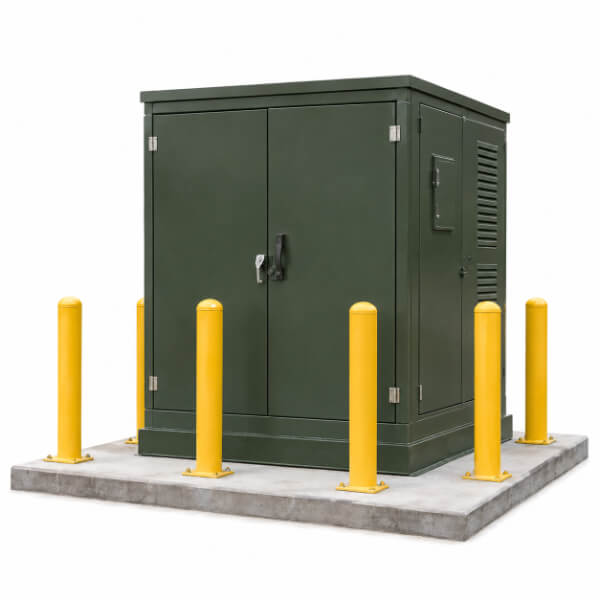
The first and most important human-factors question for any enclosure is not "how strong is the door" but "what can get in through the gaps." Ventilation louvers, cable entries, hinge clearances, drain holes, and door gaps are all potential paths from a curious hand or a probe to energized parts.
The engineering response is to define an adversary geometry and design every opening against it. In the North American framework, IEEE C57.12.28 formalizes this as a set of physical tamper tests — pry, pull, and the wire probe test — applied to the assembled enclosure. The wire probe test is the human-factors test in miniature: a straight probe, representing the coat hanger or the stick, must not be able to contact energized parts through any opening, with the door closed and manipulated. In the IEC framework, IEC 61936-1 and the IP classification system perform the equivalent function: an IP2X or IP3X boundary over accessible compartments corresponds to protection against a finger and against tools down to a defined diameter.
The subtlety is that these tests encode a philosophy, not just a pass/fail: the designer assumes the probe will be tried. Vent louvers are designed so that airflow crosses at an angle no probe can follow. Hinges are concealed or pin-protected so they cannot be driven out. Gaps that open under door flex are measured in the deflected state, not the as-built state. A well-executed enclosure is one where the manufacturer simulated the persistence of a bored twelve-year-old — because that is precisely the worst predictable user.
This is also why enclosure integrity is verified as an assembly, not from the component drawings. The gap that matters is the one that exists after the door has been pried two centimeters, not the one on the CAD model.
Public-access cabinets use a familiar hardware vocabulary: penta-head or other uncommon bolt heads, captive fasteners that cannot be dropped or removed entirely, three-point latching that secures doors at top, middle, and bottom against pry attack, and provisions for padlocks operated by the utility alone. It is tempting to read this as a list of anti-theft features. The deeper design work is in what the hardware forces a person to do, in what order.
Two examples show the difference between hardware and human factors:
The compartment-opening sequence. On a compartmentalized pad-mounted unit, the high-voltage door is typically designed so that it cannot be opened before the low-voltage door — an enforced order that guarantees whoever opens the LV side first sees, and is positioned at, the machine before reaching the more dangerous side. It is a two-second delay engineered into the door geometry, and its purpose is not to stop a trained worker. It is to make the dangerous step the second step, never the first.
The lock that is also an obstacle to rescue. Every added layer of security delays legitimate emergency access too. The standard resolution is a tiered scheme: uncommon fasteners keep out the casual public; the utility padlock controls crews; and a standard padlock hasp accepts the fire-department lock used in many jurisdictions, so that responders are carrying the key to the specific lock in front of them. The design rule embedded here is worth stating plainly: no single layer of public-area security may delay emergency response beyond minutes, because an enclosure that traps a rescue crew has traded a low-probability hazard for a certain one.
Security design in public spaces is therefore never maximization. It is choreography — who must get in, in what order, how fast, and what the enclosure does about everyone else.
A subtler human-factors issue in public areas is that the safety boundary is not only the door. The enclosure is a large piece of grounded metal standing in soil where people walk barefoot, in wet grass, during the exact weather that produces electrical faults.
During a fault, current injected into the earth raises the ground potential around the installation — and any person standing nearby can be exposed across touch (hand on the enclosure, feet on soil) and step (foot to foot) potential differences. The standards treat this directly: ANSI C2, the National Electrical Safety Code, governs grounding and clearances for publicly accessible supply equipment, and IEC 61936-1 does the same in the international framework, defining how touch and step voltages at accessible surfaces must be limited through earthing design rather than assumed away.
For the equipment designer, this has two practical consequences. First, the enclosure must be reliably bonded to a grounding system whose resistance is verified at installation — a cabinet that is merely painted-metal-connected to a corroded ground rod is a touch hazard waiting for a fault. Second, everything conductive near the equipment must share the bond: metal fences around installations are bonded to the same earthing system precisely so that a fault does not create a difference of potential between the fence and the ground beside it. A fence that protects the public from the equipment while becoming, during a fault, a hazard of its own, would be a safety feature in name only — and the bonding requirement exists to prevent exactly that inversion.
Among all public-area threats, the statistically dominant one is mundane: a vehicle. Reversing cars, snow plows, delivery trucks cutting corners, forklifts in service yards — grounded metal cabinets at grade level sit precisely at bumper height.
The human-factors reading of this hazard is that barriers work because they are noticed, not because they are strong. A steel bollard's function is half physical and half perceptual: it announces a boundary at the point where a driver is making a decision. This is why bollard placement follows the vehicle's actual path rather than the property line — set far enough back that a reasonable parking maneuver cannot reach them, close enough that they intercept the "just this once" maneuver that everyone performs eventually. Impact protection near roads and loading areas follows the same logic as the probe test: design against the predictable worst behavior, not the rule-abiding average one.
Site design completes the picture: the cabinet should not face into a reversing lane, should sit outside turning radii and fire lanes, and where exposure is unavoidable, bollards or guard rails are specified as part of the installation, not as an afterthought bolted on after the first accident.
Every publicly accessible transformer carries warning signs. And every serious safety analysis treats those signs as the weakest layer in the entire defense — because they require the one thing the public cannot be assumed to supply: attention.
A warning sign only functions at the moment and place of decision: on the door where a hand is about to act, not on the side facing the parking lot. It must communicate by symbol — the lightning-flash triangle survives translation, literacy, and childhood; text does not. It must survive weather: a sign that has faded to pastel is functionally absent, and exposure testing of the marking system is part of legitimate enclosure design, not a detail.
The mature design position is therefore blunt: assume the sign is invisible, and engineer the enclosure so that invisibility of the sign costs nothing. If the enclosure can only be described as safe "provided people read and heed the warnings," the enclosure is not finished. Signage is the final courtesy, not the defense.
The last human-factors layer concerns what people do to objects in public space over years. A ground-level cabinet, flat-topped at bench height, next to a bus stop, will be used as a bench, a table, a step, a goal post, and a climbing frame — each use importing new contact, new wear, and new chances for fasteners to work loose. A cabinet screened by dense shrubs will attract precisely the privacy that tampering prefers; concealment and safety pull in opposite directions, and sightlines usually win.
These behavioral realities produce specific, almost invisible design responses in good equipment: tops sloped or crowned so nothing rests on them, no exterior footholds or horizontal rails inviting ascent, hardware that survives paint cans and adhesive posters, enclosure heights chosen against the climbing envelope of an adult rather than merely the reach of a child, and siting guidance that keeps the equipment visible from the street without making it an obstacle. None of this appears on a nameplate. All of it determines what the installation looks like after ten years of being public property.
For engineers and project teams procuring equipment for publicly accessible locations, the human-factors intent can be audited with a short checklist:
Tamper resistance verified to a standard, as an assembly — pry, pull, and probe tests (IEEE C57.12.28 or IEC 62271-202 / IEC 61936-1 equivalents), reported for the enclosure as shipped, not inferred from drawings.
Opening geometry tested against the reach envelope — no path from any louver, gap, or cable entry to energized parts, measured in the door-deflected state.
A defined door-opening sequence — LV before HV, or equivalent enforced order — and interlocks documented, not implied.
A tiered access scheme — uncommon fasteners, utility padlock provisions, and an emergency-access path compatible with local fire-service locking practice.
Earthing designed for touch and step voltage in a public soil environment, with metal fences and barriers bonded to the same system and resistance verified on site.
Impact protection planned with the site layout — bollard positions against actual vehicle paths, clearances against NESC or local utility requirements, and sightlines kept open.
Signage specified for weather and placement at decision points — and treated as the last layer, never the first.
IEC 61936-1, ANSI C2 (NESC), IEEE C57.12.28, and the IP code family are usually cited as compliance requirements. It is more useful to read them as codified behavioral research: decades of incidents, inquiries, and near-misses, compressed into reach distances, test probes, clearance tables, and bonding rules. When a standard specifies the diameter of a test finger or the force a door must resist, it is recording what people — hands, sticks, crowbars, bumpers — have actually done to electrical equipment in public space.
Designing for that record, deliberately and explicitly, is what separates equipment that is merely certified from equipment that is genuinely safe where the public can reach it. The enclosure, the lock, the bollard, and the sign are not four features. They are one system, aimed at a single target: making sure that safety does not depend on the behavior, attention, or good judgment of the people standing next to the machine.


