Hot Keywords:
- All
- Product Name
- Product Keyword
- Product Model
- Product Summary
- Product Description
- Multi Field Search

Views: 0 Author: Welldone power Publish Time: 2026-08-27 Origin: Site


Most articles about prefabricated compact substations open the same way: a steel box containing medium-voltage switchgear, a transformer, and a low-voltage distribution board, delivered pre-wired and ready to energize. That description is accurate, and it is also the least interesting part of the story. Knowing what is inside the enclosure tells you almost nothing about why this way of building substations has spread so quickly through industrial parks, commercial developments, renewable projects, and utility networks across every continent.
The more useful question is not what a compact substation is, but where it is built — and what moves to the factory when the enclosure leaves the site. That single shift, more than any component or enclosure technology, is what redefines how distribution-level power projects are planned, specified, and delivered.
Strip away the drawings, and every substation — conventional or prefabricated — is a chain of handoffs between subsystems built by different people:
The medium-voltage switchgear hands power to the transformer through cable terminations whose insulation coordination someone had to calculate.
The transformer hands power to the low-voltage board through busbars or cables sized for a fault level someone had to agree on.
The protection relays in the MV cubicle must coordinate with the trip curves of the LV breakers downstream — a coordination study that crosses the boundary between two equipment packages.
The enclosure hands heat away from all of the above, and its ventilation capacity quietly determines whether the nameplate rating inside is real.
These boundaries — between HV and transformer, transformer and LV, protection and protection, heat source and heat sink — are where distribution projects actually fail. Not because any individual component was defective, but because the interfaces were engineered by parties who never sat in the same room. The switchgear vendor assumed one fault level; the LV board was quoted against another. The transformer was thermal-tested in free air; the enclosure vendor tested the enclosure empty. Each party is individually correct and collectively wrong.
This is the quiet, chronic disease of site-assembled substations, and it is the problem that factory pre-assembly exists to cure.
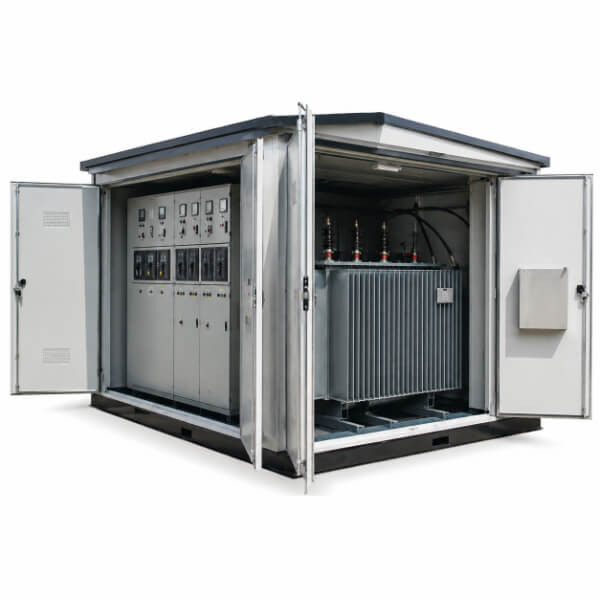
A prefabricated compact substation — the family of products also sold as compact secondary substations, package substations, kiosk substations, or skid-mounted substations, depending on the market — is defined by one governing decision: all of those interfaces are designed, wired, and verified under one roof, before the unit ever sees the site.
Typically rated between roughly 630 kVA and 2,500–3,150 kVA on the transformer side, with primary voltages in the 10–35 kV band (with 40.5 kV variants for certain markets), the unit is divided into three or four compartments inside a common weatherproof enclosure: an MV section with a ring main unit or breaker cubicle, the transformer compartment, the LV distribution section, and often a dedicated low-voltage metering or power-quality compartment. The enclosure carries an ingress protection rating — IP54 or IP55 is the practical outdoor standard — with anti-condensation heating and, increasingly, corrosion coating systems matched to coastal or industrial atmospheres.
But the compartment list is the visible 20%. The substantive change is contractual and technical at once: the interfaces that used to be the project's risk now belong to the manufacturer. The same organization that sized the transformer must make the enclosure cool it. The same team that configured the MV protection must verify it coordinates with the LV breakers it ships in the same steel box. There is no gap between vendors for a fault to hide in.
Here is the advantage that comparison tables never capture, because it cannot be expressed as a percentage saved on civil works.
When a conventional substation is built on site, each component arrives with its own factory test certificate — the switchgear passed its routine tests at its plant, the transformer at its. What is never tested, because it physically cannot be, is the assembled system. The interlock sequence between the MV switch and the compartment doors. The temperature rise of the transformer when it is dissipating into the actual enclosure, with the actual ventilation geometry, at actual load. The behavior of the protection scheme with the real cable lengths and current transformers installed.
On a live construction site, you cannot safely run a transformer at full load for eight hours to prove its thermal performance inside the room you just built. You cannot conduct an internal arc test on a structure assembled from four suppliers' equipment. You accept engineering calculations and hope.
A factory-built substation inverts this. Before shipment, the complete unit — transformer, switchgear, LV board, interlocks, heating, lighting, all of it — goes through a factory acceptance test as one machine:
Temperature-rise verification under real enclosure conditions, not free-air assumptions. This is arguably the single most valuable test in the whole process, because an enclosure that cannot reject the transformer's heat quietly derates the entire station, and no one would otherwise discover it until the first hot summer at full load.
Interlock and safety sequence proving. Every "door open only when the associated switch is isolated and earthed" claim is physically cycled, dozens of times, by people who can fix what fails.
Protection scheme functional tests with the actual CTs, wiring, and relay settings that will ship — not a simulation of them.
Type tests — including internal arc classification to IEC 62271-202 — performed on the design, so the enclosure's behavior under fault pressure relief is evidence, not promise.
What arrives at your site is not a set of components that should work together. It is a unit with a documented, witnessed, system-level test record. The difference between those two things is the difference between commissioning as verification and commissioning as discovery.
The schedule numbers quoted for compact substations — days or weeks against months — are real, but they are frequently misread as "no site work." What has actually been removed is not the site work; it is the uncontrolled site work.
What remains on site is short, definable, and almost weather-independent: a reinforced concrete plinth prepared in advance to a dimensional drawing the manufacturer issued months earlier; a crane lift of a unit whose shipping weight and lifting points were known at order time; primary and secondary cable terminations into prepared, labeled compartments; and a commissioning process that verifies what was already proven at the factory rather than trying to prove it for the first time.
Contrast that with the alternative, where the site absorbs every schedule shock: trades queuing behind each other, concrete curing on the critical path, cable trenches coordinated with three other contractors, and every weather event writing extensions into the program. The compact substation doesn't eliminate site labor so much as it removes the site from the critical path of quality. The plinth can be poured while the substation is being built 1,000 kilometers away. The two schedules run in parallel, not in series.
This parallelism — not the lifting or the cabling — is where the months actually disappear. And it is also why the format dominates the projects where it dominates: construction site power, rapidly expanding industrial estates, solar farms with grid-connection date penalties, and disaster-recovery programs where "rebuild the brick substation" is simply not an option the timeline permits.
An article that only lists advantages is a brochure. Three real trade-offs deserve a place in any serious evaluation:
1. Thermal density is the design constraint that rules everything. Compressing a transformer, its losses, and two switchgear lineups into the smallest possible footprint concentrates heat into the smallest possible volume. Above roughly 1,600–2,000 kVA in a compact enclosure, passive ventilation starts surrendering to forced ventilation, and forced ventilation introduces fans — filters, bearings, failure modes, maintenance — into what was previously a static system. A well-engineered unit manages this honestly, with a verified temperature-rise margin at rated load. A poorly engineered one ships a nameplate rating that the enclosure quietly cannot support. This is precisely why the factory temperature-rise test described above is non-negotiable in a good specification.
2. Maintenance access is designed in or designed out — permanently. In a conventional substation building, you can usually find a way to get a lifting rig, a replacement breaker, or two technicians and a drawing set into the room. In a compact enclosure, every access scenario had to be anticipated years earlier: compartment door geometry, withdrawable versus fixed breaker formats, transformer replacement strategy (in severe designs, the whole unit returns to the factory), and whether a person can safely inspect live adjacent compartments while one is opened. Buy a poorly considered layout and every subsequent service event inherits that mistake for the life of the asset.
3. There is an upper bound, and pretending otherwise costs money. Above approximately 5 MVA, or where heavy busbar interconnection, extensive arc-rated switchgear lineups, or utility-operational requirements dominate, the conventional substation remains the correct engineering answer. Compact substations won their territory at the distribution level — and the manufacturers who push the format far beyond its thermal and access limits sell their clients a decade of operational frustration along with the enclosure.
None of these caveats argue against the format. They argue for specifying it with the same engineering rigor the factory applied to building it.
For engineers preparing to procure one, five requirements separate a serious factory-built substation from a shed with equipment inside:
A system-level temperature-rise test report on the actual design — transformer installed, doors closed, at rated load — not a transformer free-air test plus an enclosure brochure.
Internal arc classification (IAC) to IEC 62271-202 for the MV compartments, with the test class matched to where people will actually stand.
A witnessed functional test of the complete unit at FAT — interlocks, protection tripping, indication, heating, and lighting — with a defined protocol issued before the test date, so the witness watches a test rather than a demonstration.
A single-line diagram, protection coordination study, and interface schedule issued for approval early, and a stated single point of technical responsibility for the complete assembly — because divided responsibility is precisely the disease the format exists to cure.
Site-side deliverables defined in the contract: plinth loading drawings, lifting points, cable entry positions and gland plate provisions, and a commissioning checklist that assumes factory tests were witnessed and passed.
The fifth point deserves emphasis. The entire value proposition collapses if the factory hands the site an unverified box, or the site treats the delivered unit as unproven. The prefabricated substation works as a system of proof — factory evidence in, site verification on top — and the specification is what binds those two halves together.
Zoom out, and the prefabricated compact substation is one instance of a broader migration across the power industry: wherever equipment can be integrated and verified under controlled conditions, it will be. The project schedule, the quality record, and the risk profile all improve for the same underlying reason — fewer uncontrolled interfaces, executed under controlled conditions, with one accountable throat to choke.


