Hot Keywords:
- All
- Product Name
- Product Keyword
- Product Model
- Product Summary
- Product Description
- Multi Field Search

Views: 0 Author: Welldone power Publish Time: 2026-09-10 Origin: Site


Ask why offshore wind turbines use dry-type transformers in the nacelle, and you will get a clean answer: no oil. In a confined steel enclosure 100 meters above the sea, a liquid-filled unit introduces a fire load, a spill pathway into a marine environment, and a maintenance burden that requires a vessel, a weather window, and a crew to reach. A cast-resin dry-type transformer eliminates all three problems at once. For a nacelle installation, that is usually decisive.
But it is worth being precise about what that decision does, because the industry often presents it as a simple advantage rather than a trade. Choosing dry-type offshore does not remove four hard problems. It swaps them for four different ones — and unlike the oil question, none of the replacements can be solved by choosing a different product family. They have to be designed against, mechanism by mechanism.
The four are: a salt deposit that turns insulating surfaces conductive; condensation that forms inside whatever enclosure you build to keep the salt out; a fundamental conflict between sealing the unit and cooling it; and a mechanical environment — continuous vibration, tower sway, and yaw transients — for which the transformer was never the intended load path. This article takes them in that order, because that is roughly the order in which they destroy equipment.
The conventional framing is that salt fog corrodes offshore equipment, so the countermeasure is better coating and stainless hardware. That framing is incomplete, and the gap matters enormously for a dry-type transformer specifically.
Airborne sea salt does not simply sit on surfaces. It deposits as a hygroscopic layer — chloride salts that readily absorb atmospheric moisture. At high relative humidity, and especially through the dew-point crossings that occur daily offshore, that deposit absorbs water and forms a thin electrolyte film on the insulation surface. The insulation has not failed internally. Its surface has become conductive.
This produces a failure mode that onshore designs are not dimensioned for: surface flashover across the creepage path, often called pollution flashover, occurring at voltages the bulk insulation would comfortably withstand. It is a surface phenomenon, driven by contamination and moisture, and it is one of the recognized fire initiators in offshore wind turbines precisely because it happens on equipment that passes every factory dielectric test in a clean, dry condition.
Design answers follow directly from the mechanism:
Creepage length extended beyond the onshore standard. The surface path between phases and to earth is lengthened deliberately to survive a contaminated, wetted surface — not merely a clean one. Insulator profiles and winding geometry are chosen against the polluted condition, not the ideal one.
Hydrophobic surface treatment. A surface that sheds water into droplets rather than allowing a continuous film breaks the electrolyte bridge before it forms. Room-temperature-vulcanizing (RTV) silicone coatings and hydrophobic resin formulations serve exactly this function, and their retention over years — not merely their initial application — is the performance question.
Sealing the unit rather than protecting it. If the salt never reaches the winding, the surface conductivity mechanism is designed out at the source. This is why offshore dry-type units are installed inside enclosures rather than exposed, with the corrosion burden transferred to the enclosure shell. It is a good answer — and it is the direct cause of the next two problems.
Sealing against salt ingress sounds like a complete solution. It is not, because a sealed enclosure does not eliminate water — it relocates it.
Inside the enclosure, moisture is still present: residual humidity from assembly, desorption from insulation and structural materials, and whatever enters through imperfect sealing over years of thermal cycling. Meanwhile, the enclosure experiences the offshore thermal environment — day-night cycling, load cycling that swings winding temperature by tens of kelvin, and cold starts after an outage. Each cooling cycle pushes internal surfaces below the local dew point. Water condenses. And it condenses preferentially on the coldest, most thermally massive surfaces, which is frequently the winding and its insulation, not the enclosure wall.
The consequence is a subtle inversion of the outdoor problem: instead of salt arriving from outside, moisture is generated and trapped inside, wetting the same insulation surfaces from within a space the operator cannot inspect. Long-term, this drives down surface insulation resistance and creates the conditions for discharge at the surface — the same failure class as Mechanism One, arrived at by a different route.
Countermeasures are well established, and each one is a maintenance commitment rather than a one-time feature:
Anti-condensation heaters, energised whenever the transformer is de-energized, keeping internal surfaces above the dew point during the coldest and most vulnerable state — the outage.
Dehumidification and desiccant management, with a replacement or regeneration schedule that assumes a vessel trip.
Breathing management — either genuinely sealed construction with pressure compensation, or controlled breathing through a desiccant path, because a nominally sealed box that breathes uncontrolled air simply imports the salt problem it was built to exclude.
Thermal design that avoids cold spots, since the condensation site is set by the temperature gradient, not by the enclosure's nominal rating.
The design principle worth stating plainly: sealing is not a moisture strategy. It is a boundary condition that makes internal moisture management mandatory.
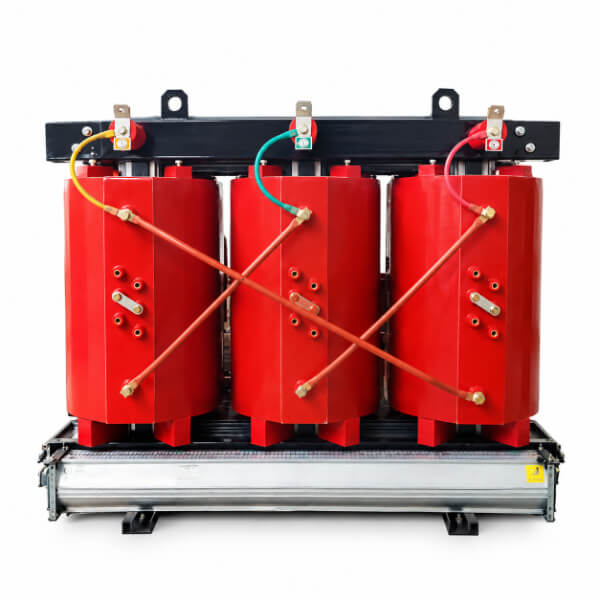
Here is the central engineering tension of offshore dry-type design. A dry-type transformer rejects heat to air. Its rating, in practice, is a statement about how much air can carry heat away. Offshore, the enclosure must be sealed against salt. A sealed enclosure cannot reject heat by air exchange.
Every available resolution is a trade:
Air-to-air heat exchangers. Internal air circulates through a closed loop; external air passes on the other side of a heat exchanger, transferring heat without mixing the two streams. Salt never reaches the winding. The cost is a heat-transfer path with a temperature differential across it — meaning the transformer runs hotter internally than the external air would suggest — plus a heat exchanger that fouls with salt on its external surfaces and requires cleaning, offshore, on a schedule.
Air-water cooling. Heat is transferred from internal air to a water circuit, then rejected through an external exchanger or the turbine's own cooling system. This is more compact and allows the transformer compartment to be held at slight positive pressure, which actively resists salt ingress. It also introduces a water circuit — pumps, seals, pressure integrity — into a location where a leak is both a maintenance event and an electrical hazard. Higher capability, higher complexity, higher consequence of failure.
Forced ventilation with filtration. The simplest thermal answer, and the worst maintenance answer offshore: filters that exclude salt load up with salt and must be serviced, and a neglected filter converts a cooling system into an overheating risk. Every filter is a scheduled intervention, and every scheduled intervention is a vessel trip.
Derating and thermal margin. Accept a lower usable rating, or a higher class of insulation system, so the unit tolerates a compromised cooling path without damage. This is the most honest option — it costs capacity and capital up front and buys tolerance to the degradation that will inevitably occur — and it is routinely under-specified because it makes the equipment look more expensive in a competitive tender.
The right answer for a given project is a function of turbine size, ambient temperature range, maintenance access, and the operator's tolerance for interventions. What matters is that the trade is made explicitly. A dry-type transformer specified for offshore without a stated cooling architecture and a stated thermal margin is not a design — it is a hope that the enclosure will behave as the datasheet assumes.
A nacelle is a machine that never stops moving. Rotor rotation, blade-pass harmonics, generator and gearbox excitation, continuous tower sway, and the abrupt transients of yawing and braking all couple into every component bolted inside it. A dry-type transformer, with its cast resin body and bolted core-and-clamp assembly, is not naturally a fatigue-rated structure.
The damage accumulates in unglamorous places: bolted joints that creep and loosen; conductor terminations that work-harden and crack; insulation surfaces that abrade against adjacent structures over millions of cycles; and, in the worst case, winding movement relative to the core that begins as an electrical nuisance and ends as a fault. None of these show up in a routine dielectric test until they are already advanced.
Design and installation countermeasures are mechanical, and they are largely about eliminating relative motion rather than adding strength:
A rigid cast body, so the winding structure resists movement as a single piece rather than as an assembly of parts that can work against each other.
Positive tie-down between transformer and enclosure, with bracing that makes the two behave as one structure instead of two masses that can oscillate independently.
Anti-loosening provisions on every fastener, treated as a fatigue requirement rather than a good practice, because a fastener that loosens under vibration has become a moving part.
Strain relief and support for all connections, so that cables and busbars do not impose cyclic loads on terminals.
Dynamic qualification, not just static certification — the mechanical environment offshore is a vibration spectrum and a transient load history, and the equipment should be justified against that environment explicitly.
Because the enclosure absorbs the corrosion burden, its specification is where most of the offshore durability is won or lost. Three elements matter:
Corrosivity classification. Offshore atmospheric corrosivity is high, and the relevant framework is ISO 9223, with C5-M denoting the severe marine category. This classification is the input to everything that follows.
Coating systems specified to a standard, not a colour. ISO 12944 governs protective coating systems: surface preparation grade, coating chemistry, number of coats, dry-film thickness, and the durability expectation over the intended life. A coating specified as "marine grade" without a system designation and a film thickness is an assertion, not a specification. Edges, fasteners, and welded joints are where coating systems actually fail, and they require detailing — stripe coats, sealed joints, and corrosion-resistant hardware — rather than a uniform spray.
Material compatibility. Stainless steel and aluminium enclosures bring their own issues: galvanic corrosion between dissimilar metals, chloride stress corrosion cracking in some stainless grades, and hydrogen embrittlement risk in high-strength fasteners. Material selection has to be made as a system, with the fasteners and the structure considered together.
Ingress protection as a declared boundary. The IP rating is not a marketing number; it defines what the enclosure claims to exclude and, therefore, what the internal design must assume about what gets in anyway. Ventilation openings, cable entries, and door seals are the paths that matter, and cable entry design is where a well-rated enclosure most often becomes a poorly-rated installation.
For offshore dry-type transformers, the applicable framework typically includes:
IEC 60076-11 — dry-type transformers, covering the climate, environmental, and fire-behaviour classes (commonly expressed as a class triplet such as C2 / E2 / F1) that should be stated explicitly for offshore service rather than inherited from a generic catalogue.
IEC 60076-16 — transformers for wind turbine applications, the standard that acknowledges the specific duty cycle, load profile, and environmental exposure of this application.
IEC 61439 — where the assembly is supplied as a switchgear-and-transformer combination, governing the enclosure and assembly requirements.
IEEE C57.12.01 — for North American dry-type specifications.
ISO 9223 and ISO 12944 — corrosivity classification and coating system specification, as described above.
Classification society certification (for example DNV) where the project requires it, particularly for floating or offshore substation installations.
A short, pointed checklist for procurement teams:
A stated cooling architecture with a thermal margin. Heat exchanger, water circuit, forced ventilation, or derated operation — named, with the derating or margin quantified.
A creepage specification justified for a polluted, wetted surface — not merely compliance with a clean-condition minimum.
A condensation management plan, including heater operation during outages and the desiccant or dehumidification schedule, with a realistic intervention interval given offshore access.
A vibration and dynamic qualification statement against the actual nacelle environment, including tie-down and fastener anti-loosening provisions.
A coating system specified by standard — ISO 12944 system, surface preparation grade, and dry-film thickness, with edge and fastener detailing called out.
Class designations stated explicitly — climate, environmental, and fire class, plus IP rating, plus corrosivity category.
A maintainability plan that accounts for the cost of access. A design that requires a vessel trip every six months to service a filter has a total cost that dwarfs its purchase price, and that cost belongs in the evaluation.
Dry-type transformers are the right answer for offshore nacelles, for reasons of fire safety and oil containment that no other technology matches at that location. But the salt fog, the condensation, the sealing paradox, and the vibration do not go away because the oil did. They convert from problems the oil handled passively into problems the design must handle actively — with extended creepage, hydrophobic surfaces, deliberate moisture management, a cooling architecture chosen with its maintenance burden in view, and a mechanical design that treats every fastener as a fatigue component.
Offshore wind rewards the projects that specify these mechanisms explicitly, and punishes — expensively, at sea, in a weather window — the ones that assume that a sealed enclosure and a marine coating together constitute a complete answer. They do not. They are the first two moves in a longer engineering argument, and the transformer's thirty-year life at sea depends on how well the rest of it is made.


