Hot Keywords:
- All
- Product Name
- Product Keyword
- Product Model
- Product Summary
- Product Description
- Multi Field Search

Views: 0 Author: Welldone power Publish Time: 2026-06-22 Origin: Site


Every electronic device, from a simple smartphone charger to a massive industrial motor, relies on a consistent supply of voltage. But the electricity that comes from the grid is rarely perfect – it dips during peak demand, surges when heavy machinery starts, and fluctuates with weather or grid faults. Left unchecked, these variations can degrade sensitive components, cause erratic behavior, or even permanently destroy expensive equipment.
That is exactly where a voltage stabilizer steps in. It sits between your mains supply and your load, actively smoothing out those incoming swings so that your equipment always receives a steady, rated voltage. Unlike a simple surge protector that only clips extreme spikes, a stabilizer continuously adjusts its output to keep it within a tight tolerance band. In many ways, it is the unsung guardian of modern electronics – always working, rarely noticed, but absolutely vital.
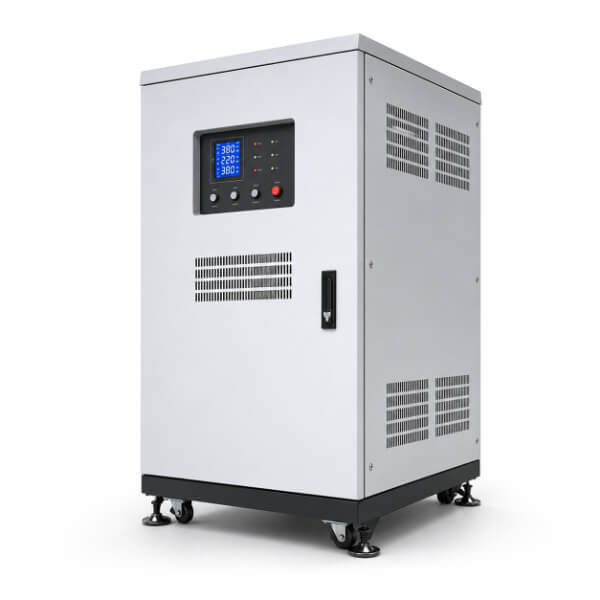
At its heart, a voltage stabilizer runs on a feedback control loop. Think of it as a vigilant operator who constantly watches the output voltage, compares it against a fixed internal reference, and instantly corrects any deviation. This happens through three repeating steps:
Sensing – A detection circuit measures the actual output voltage in real time.
Comparing – That measured value is compared with a stable reference voltage; if they differ, an error signal is generated.
Acting – Based on that error, an adjusting element (either electronic or electromechanical) modifies the circuit’s behavior – reducing or increasing the effective turns ratio, duty cycle, or series resistance – until the output returns to the set point.
The beauty of this mechanism is that it is fully automatic and continuous. The response speed, accuracy, and efficiency of a stabilizer largely depend on how this loop is implemented – which brings us to the different families of stabilizers available today.
Not all stabilizers are created equal. Each design philosophy offers a distinct balance of cost, precision, efficiency, and physical size. Here is a practical breakdown:
Linear stabilizers use a pass transistor that acts like a variable resistor. When the input voltage rises, the transistor increases its resistance to drop the excess voltage as heat; when input drops, it reduces resistance to let more through. This approach yields exceptionally clean output with very low ripple and minimal electrical noise – a trait cherished in audio amplifiers, precision measurement circuits, and radio frequency stages. The downside? They can only step down voltage, and their efficiency rarely exceeds 60%, meaning significant power is wasted as heat. They are best suited for low‑power, noise‑sensitive applications where battery life or heat dissipation is not the primary concern.
Switching stabilizers take a completely different route. They rapidly turn a power switch on and off, creating a high‑frequency pulsed waveform, which is then smoothed by inductors and capacitors to produce a steady DC output. Because the switch is either fully on or fully off (with very little time spent in between), internal losses are minimal – efficiencies often reach 90‑95%. Moreover, switching topologies can easily boost voltage (step‑up), reduce it (step‑down), or even invert it, all within a compact footprint. The main compromises are a slightly higher output ripple (which can be mitigated with additional filtering) and the generation of electromagnetic interference that may require careful layout and shielding. You will find switching regulators inside laptop adapters, LED drivers, battery chargers, and virtually every modern power supply.
For large‑scale industrial loads or medical imaging systems that demand ultra‑tight voltage stability (often ±1% or better), servo‑based stabilizers are a common choice. These units employ a motor‑driven carbon brush that glides along an autotransformer winding, changing the turns ratio to compensate for input variations. Because the adjustment is mechanical and continuous, the output stays remarkably flat even under fluctuating line conditions. They are available from a few kilovolt‑amperes up to several megavolt‑amperes. However, their mechanical nature introduces slower response times (hundreds of milliseconds) and eventual wear of the brush and commutator, so they require periodic maintenance.
A more budget‑friendly option uses a set of relays to switch between different taps on a transformer. When the input voltage moves out of bounds, the relay closes a different tap to bring the output closer to nominal. This design is straightforward, rugged, and inexpensive, but it offers coarse regulation – typically within ±8‑10% – and the switching action can cause brief interruptions or arcing. You will often see relay stabilizers protecting household refrigerators, air conditioners, and other appliances where a small voltage dead‑band is acceptable.
Other niche variants include ferroresonant (magnetic) stabilizers that use saturable core reactors for inherent regulation, and fully solid‑state AC regulators that combine thyristors with electronic control for fast, maintenance‑free operation. Each finds its place in specialized environments like railway systems, data centers, or remote off‑grid installations.
When comparing stabilizers, you will encounter a range of technical numbers. Rather than getting lost, focus on these five critical metrics:
Input Voltage Window – The minimum and maximum AC or DC voltages the unit can accept and still regulate. A wider window is preferable for areas with notoriously poor grid quality.
Output Voltage Accuracy – Usually expressed as a percentage (e.g., ±1%, ±5%). This tells you how closely the stabilizer holds its output to the rated value. Precision instruments need tight accuracy; ordinary motors can tolerate looser bounds.
Efficiency – The ratio of output power to input power. Higher efficiency means lower electricity bills and less heat generation, which is especially important for continuous operation.
Load Regulation – How much the output voltage changes when the load current varies from zero to full load. A good stabilizer keeps this shift minimal.
Line Regulation – How much the output shifts when the input voltage changes while load is constant. This reflects the stabilizer’s ability to reject upstream disturbances.
Response Time – The time needed to correct a step change in input or load. Faster is better for sensitive electronics, but slower mechanical types may still suffice for heavy inductive loads.
Do not overlook environmental factors: operating temperature, humidity, altitude, and cooling requirements can significantly affect real‑world performance.
You might be surprised by how many areas rely on these devices:
Consumer Electronics – Smartphones, tablets, and laptops contain multiple internal stabilizers (mostly switching and linear) to supply clean, regulated rails to processors, memory, and displays.
Industrial Automation – Programmable logic controllers (PLCs), variable frequency drives, and sensors can malfunction or suffer damage if supply voltage drifts; stabilizers prevent costly production stoppages.
Telecom Infrastructure – Base stations, routers, and fiber‑optic transceivers demand stable power to maintain signal integrity and avoid dropped connections.
Medical Equipment – MRI scanners, patient monitors, and ventilators cannot tolerate voltage deviations. Here, high‑precision servo or double‑conversion online stabilizers are often mandated by regulatory standards.
Automotive Systems – In‑vehicle electronics (infotainment, ADAS, battery management) must cope with wide input swings from the alternator and battery, making robust stabilizers a necessity.
Household Appliances – Even though many modern appliances have built‑in protection, adding a whole‑house or dedicated stabilizer extends their lifespan and improves performance during brownouts.
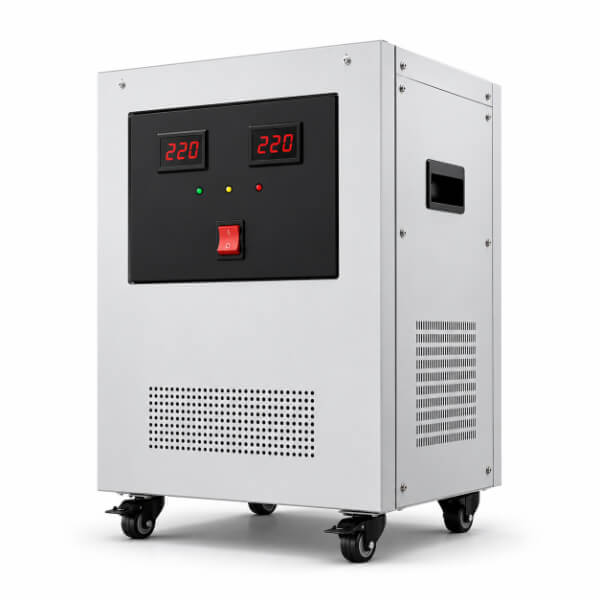
Selecting a stabilizer is not about picking the most expensive or the most feature‑rich model; it is about matching the device to your actual needs. Follow this step‑by‑step process:
Calculate total load power – Add up the wattage (or VA) of all devices that will run simultaneously. For motors, compressors, and pumps, account for the start‑up inrush current, which can be 3‑7 times the running current. Always choose a stabilizer with at least 20‑30% extra capacity to avoid overloading.
Analyze your grid environment – Use a power quality logger or check with your utility to know the typical low and high voltage extremes. The stabilizer’s input range must comfortably cover these extremes.
Determine the required output accuracy – If you are protecting a CNC machine or a laboratory analyzer, aim for a servo or solid‑state unit with ±1% or better. For general household use, a relay‑type with ±10% may be perfectly fine.
Consider efficiency and cooling – For 24/7 operation, higher efficiency saves significant energy over time. Also verify whether the unit uses natural convection or forced‑air cooling, and ensure adequate ventilation space.
Evaluate response time and noise – If your load is sensitive to short interruptions (e.g., computers with no UPS), prioritize fast‑responding electronic designs. If audible noise is a concern, avoid servo types with constant motor whirring.
Factor in installation and maintenance – Wall‑mount, floor‑standing, or rack‑mount? Does it need remote monitoring or communication ports? How often do brushes or capacitors need replacement? These practicalities affect long‑term ownership.
Budget vs. value – Cheaper relay or linear stabilizers have lower upfront costs, but may waste energy or require earlier replacement. A more efficient switching or servo model often pays back through lower electricity bills and reduced downtime.
Voltage stabilizers are far more than simple add‑ons; they are strategic investments in reliability, safety, and equipment longevity. Whether you are safeguarding a life‑support system, a factory production line, or your home entertainment setup, understanding the underlying technology empowers you to make informed choices. By considering your load characteristics, power environment, and accuracy needs, you can select a stabilizer that delivers years of trouble‑free service – quietly doing its job while you focus on what truly matters.
The next time you see a voltage stabilizer, remember that it is not just a box of coils and circuits; it is a tireless guardian that turns chaotic power into steady, usable energy – and that makes all the difference.


