Hot Keywords:
- All
- Product Name
- Product Keyword
- Product Model
- Product Summary
- Product Description
- Multi Field Search

Views: 0 Author: Site Editor Publish Time: 2025-12-05 Origin: Site


Moisture and persistent rainfall change the rules of electrical equipment design and maintenance. Transformers installed in humid or rain-heavy regions face accelerated insulation aging, corrosion, condensation-related faults, and frequent surface leakage. Choosing the right transformer — and specifying the right protective measures — prevents outages, reduces life-cycle costs, and improves overall site safety. This article outlines a practical, procurement-ready approach that balances performance, maintenance burden, and cost.
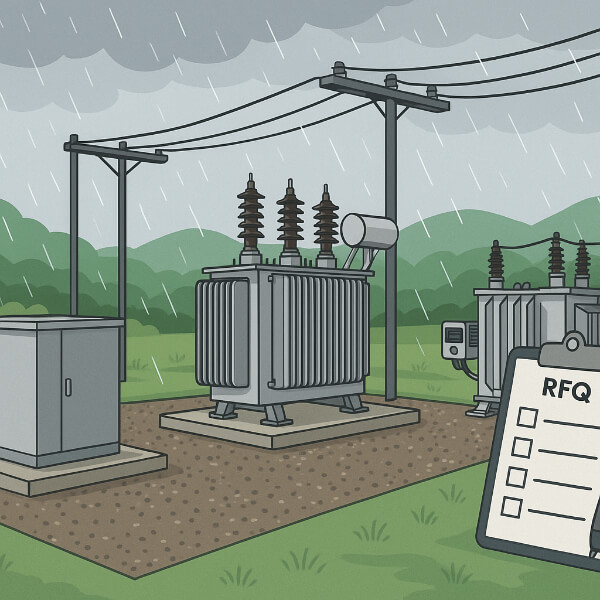
Humidity and rain introduce three core problems for transformers:
Moisture ingress and absorption: Paper and pressboard insulation absorb water, reducing dielectric strength and speeding up insulation breakdown.
Corrosion: Tanks, bolts, bushings and connectors corrode sooner where humidity and airborne salts exist.
Condensation & surface tracking: Temperature swings cause water to condense inside cabinets and on insulating surfaces, increasing leakage currents and flashover risk.
Understanding these failure mechanisms helps select both transformer type and site protection measures that reduce risk.
Oil-filled transformers (mineral or ester oils)
Advantages: Economical for medium and large ratings, good cooling capacity, familiar to utilities.
Challenges: Oil can absorb moisture; breathers and conservator systems need careful management. Prefer designs that keep air exchange with the tank to a minimum.
Dry-type transformers (cast-resin or VPI)
Advantages: No oil to manage or spill, inherently safer indoors, fewer issues with oil moisture.
Challenges: Generally more costly for large MVA ratings and sensitive to pollution unless housed.
Practical choice: If reliable oil testing and maintenance are available, modern oil-filled designs with tropicalization work well for large stations. Where maintenance is limited, or environmental/safety restrictions exist, cast-resin dry types are often preferable.
When preparing an RFQ or purchase spec for humid environments, prioritize these items:
Sealing & conservator strategy: Prefer hermetically sealed tanks or diaphragm/bladder conservators that reduce ambient air ingress. Hermetic tanks lower the dependence on breathers.
Breathers & dehydration: If a conservator is used, require replaceable silica-gel breathers or vacuum dehydration provisions and clear maintenance intervals.
Anti-condensation heaters: Thermostatically controlled heaters in the tank and control cubicles prevent nighttime condensation and should be included.
Corrosion protection: Marine-grade painting system (epoxy primer + polyurethane topcoat), stainless or hot-dip galvanized fasteners, and sacrificial anodes where applicable.
Bushings & insulators: Consider hydrophobic polymer/composite bushings in polluted or coastal locations; they shed water better than plain porcelain.
Control cabinet ratings: Specify an ingress protection of IP54 or higher (IP65 for extremely exposed electronics). Include internal heaters and filtered vents.
Insulation class & temperature rise: Ask for higher thermal classes (e.g., Class F) and conservative temperature rise limits to extend insulation life under humid conditions.
Surge & lightning protection: Hardening against transients is more important where moisture can reduce margin against flashover.
Elevate the foundation: Place transformers on raised concrete pads above flood level; slope surrounds for rapid drainage.
Provide a simple canopy: A modest roof or shelter significantly reduces wind-driven rain on bushings and radiators.
Position vents and drains carefully: Route vent openings away from prevailing wind and rain directions and ensure drains cannot clog.
Cable entry & trenches: Use sealed, elevated cable entries with slope to prevent water ingress into the cable box.
Grounding considerations: Waterlogged soils change earth resistance — plan multiple electrodes or chemical earthing where necessary and validate with site tests.
A proactive maintenance program is the most cost-effective protection:
Visual checks: Weekly/biweekly inspections for oil leaks, rust, pooled water, bird nests and damaged seals.
Breather and heater checks: Monthly checks on silica-gel condition and heater function; treat breathers as routine replaceable consumables.
Oil testing: Yearly or more frequent oil sampling with DGA, moisture (ppm), and BDV tests for oil-filled units.
Periodic offline testing: Power factor, tan delta, and insulation resistance checks every 3–5 years or after abnormal events.
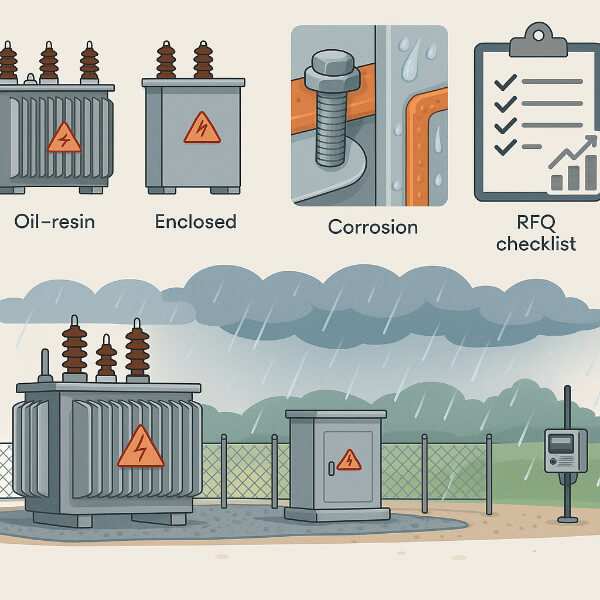
Include these line items in technical bid documents:
Transformer type (oil-immersed hermetic or cast-resin dry) and MVA/kV ratings.
Sealing system (hermetic/conservator with bladder), silica-gel breathers, and dehydration provision.
Anti-condensation heaters with thermostat control.
Tropicalized paint system, stainless hardware, and salt-spray test requirement.
Polymer/composite bushings or high-grade porcelain with hydrophobic sheds.
Control cubicle IP rating and internal heater.
Factory test deliverables: DGA, oil moisture (ppm), BDV, insulation resistance, and witness test report.
Coastal sites need more aggressive corrosion mitigation and shorter service intervals. Mountainous sites may face larger diurnal swings — increase heater capacity. Polluted industrial atmospheres require more frequent cleaning and possibly filtered ventilation for control electronics.
Choosing the right transformer for humid, rain-prone areas is more than picking oil vs. dry. It requires a systems approach: match transformer construction to maintenance capability, specify sealing and anti-condensation measures, tropicalize materials, design the site to keep water away from critical parts, and invest in monitoring. Thoughtful specifications and modest site protections often deliver outsized improvements in reliability and life-cycle cost.


