Hot Keywords:
- All
- Product Name
- Product Keyword
- Product Model
- Product Summary
- Product Description
- Multi Field Search

Views: 0 Author: Site Editor Publish Time: 2025-11-25 Origin: Site


An earthing (grounding) transformer creates a secure, controllable neutral for power systems that otherwise lack one. Whether used to protect equipment, stabilize voltages, or provide a reference for protection relays, an appropriately specified earthing transformer is a small device with outsized impact on safety and reliability. This article explains what earthing transformers do, how they’re built and applied, how to size and select one, and practical tips for installation, testing, and upkeep — written for engineers, procurement teams, and plant operators who need an actionable, SEO-friendly reference.
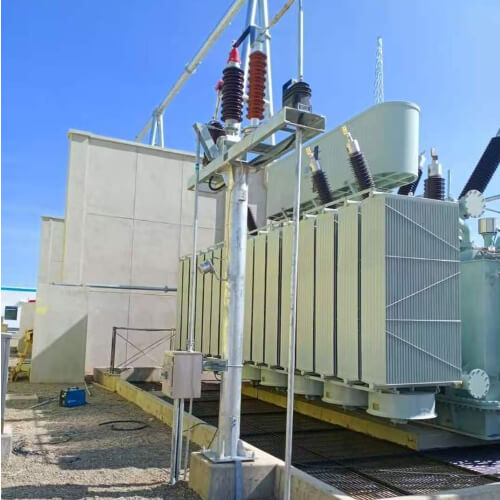
Many industrial and utility networks (especially delta-connected or certain inverter-coupled systems) do not have a neutral point available. Without a neutral, single-line-to-ground faults behave unpredictably and protective equipment can’t detect them reliably. An earthing transformer:
Produces a defined neutral point for protection relays and metering.
Controls the magnitude of ground-fault currents (when used with a resistor or reactor).
Helps reduce transient overvoltages during ground faults.
Improves personnel and equipment safety by providing a known ground-return path.
In short: if your system must detect or limit ground faults, or if regulators/standards require a grounded neutral, an earthing transformer is the right tool.
There are three common practical configurations:
Zig-zag (Z) transformer — Compact and efficient. It uses interlaced windings on a three-limb core that synthesize a neutral without carrying normal-load currents. Zig-zag units are the most common choice where zero-sequence impedance control is required.
Open-delta (two-phase) earthing transformer — Built from two single-phase units wired in an open-delta arrangement. Simpler conceptually, sometimes used for retrofit jobs where full three-phase replacement is undesirable.
Wye-star neutral winding — Provided as a separate neutral winding on a larger distribution transformer or as a dedicated star-connected unit. This arrangement can be preferable when a single transformer already serves multiple functions.
Each topology behaves differently in terms of zero-sequence impedance, magnetizing current, size, and cost. Zig-zag units typically provide the best balance of compactness and zero-sequence performance.
Selecting a grounding strategy is as important as selecting the transformer:
Solid grounding — neutral tied directly to earth; fault currents equal system prospective values. Simple but produces high ground-fault currents.
Resistive grounding (NGR) — neutral connected through a neutral grounding resistor to limit fault current to a designed value. Widely used to limit thermal/mechanical stress and reduce damage.
Reactive grounding (grounding reactor/Petersen coil) — neutral through an inductor to counteract capacitive fault currents; lowers arc-sustaining currents in certain networks.
Resonant grounding — reactor value tuned to network capacitance to reduce fault current to very low levels; used in select distribution systems.
An earthing transformer is often paired with an NGR or grounding reactor to achieve the desired ground-fault current profile.
A structured approach avoids oversizing or under-performing equipment:
Collect system data: system voltages, frequency, three-phase fault level at the connection point, system impedance, and site limits (ambient, altitude).
Decide required maximum ground-fault current (I_limit) based on relay sensitivity, equipment ratings, and safety rules.
Determine NGR/reactor requirements: if using resistive grounding, calculate resistor value R_n = V_phase-to-neutral / I_limit. (Use absolute phase-to-neutral voltage values.)
Choose zero-sequence impedance: the transformer's zero-sequence reactance plus any reactor determines fault current distribution and transient response. Specify X0 (or Z0) in ohms or percent.
Pick transformer KVA: ensure thermal short-time rating is adequate for the expected fault energy and that magnetizing characteristics prevent saturation under transient conditions. Typical KVA sizing covers fault duty rather than continuous load.
Define mechanical & environmental requirements: indoor/outdoor enclosure, IP rating, seismic restraints, lifting points, and terminal arrangement.
List protection & monitoring: RTDs, pressure-relief, oil-level/DGA for oil units, neutral terminal block, and provisions for NGR mounting.
Include required standards and factory test documentation in procurement (e.g., routine, type, and short-circuit tests; insulation and ratio verification).
For a 11 kV delta-fed distribution system where relays must see ground faults but you want to limit fault current to e.g., 200 A, specify a zig-zag earthing transformer with X0 sized for coordinated transient response and an NGR sized for 200 A continuous during the clearing interval.
For systems prone to sustained arcing (e.g., long cable networks with significant capacitance), consider reactor or resonant grounding instead of pure resistive grounding.
(If you want a worked numeric example with stepwise resistor and transformer KVA calculations, tell me your system voltage and target I_limit and I’ll compute it here.)
Pre-delivery: review transformer factory test reports (ratio, polarity, winding resistance, insulation).
Mechanical installation: firm mounting, correct earthing of tank/frames, and accessible neutral terminal for NGR/reactor connection.
Electrical connections: follow torque specs for bushing/terminal connectors; use phase-marked terminations.
Commissioning tests: insulation resistance, polarity/ratio checks, and a functional test of the NGR or reactor under controlled conditions.
Protection coordination: verify that ground-relay pickup thresholds and time settings correctly detect the reduced-ground-fault currents when an NGR is present.
Always isolate and tag out equipment during maintenance; neutral circuits may still present danger if incorrectly handled.
Routine visual checks: enclosure integrity, terminal tightness, signs of overheating, and ventilation.
Periodic testing: insulation resistance, RTD checks, and DGA/oil-sampling for oil units.
NGR maintenance: resistors should be inspected and load-tested per transformer manufacturer recommendations.
Record keeping: log all faults, trips, and maintenance actions to identify trends and preempt failures.
Pros: gives predictable ground-fault behavior, enables protection for otherwise ungrounded systems, compact zig-zag designs.
Cons: adds cost and equipment complexity; oil-filled types require oil handling and periodic testing.
When to avoid: if a system is already solidly grounded at a main transformer or if site constraints prohibit adding another transformer and neutral arrangements can be achieved by other means.
System voltage & frequency
Desired ground-fault current limit or grounding philosophy
Transformer topology (zig-zag / open-delta / star)
KVA rating and short-time withstand requirement
Insulation (BIL), bushings, and terminal layout
Cooling and enclosure type (dry vs oil, indoor/outdoor)
Monitoring and accessories (RTDs, breather, neutral link for NGR)
Required test reports and applicable standards
An earthing transformer is a precisely targeted solution for neutral creation and ground-fault control in systems that lack a natural neutral point. Proper selection — balancing transformer impedance, grounding strategy, physical constraints, and protection coordination — prevents equipment damage, reduces downtime, and keeps personnel safe. With clear system data up front, you can choose a compact, reliable unit that integrates smoothly with your protection philosophy and long-term maintenance plan.


