Hot Keywords:
- All
- Product Name
- Product Keyword
- Product Model
- Product Summary
- Product Description
- Multi Field Search

Views: 0 Author: Welldone power Publish Time: 2026-05-14 Origin: Site


When you work with power transformers long enough, you realize they’re not just a single heavy box sitting on a concrete pad. They are a carefully assembled system of dozens of individual parts, each with a specific job. If you’ve ever wondered what’s actually inside that oil-filled steel tank or how a dry‑type unit survives without any liquid, here’s a down‑to‑earth tour.
I’ll focus first on the oil‑immersed type (the most common one you see in substations or on utility poles), then quickly cover how dry‑type transformers differ.
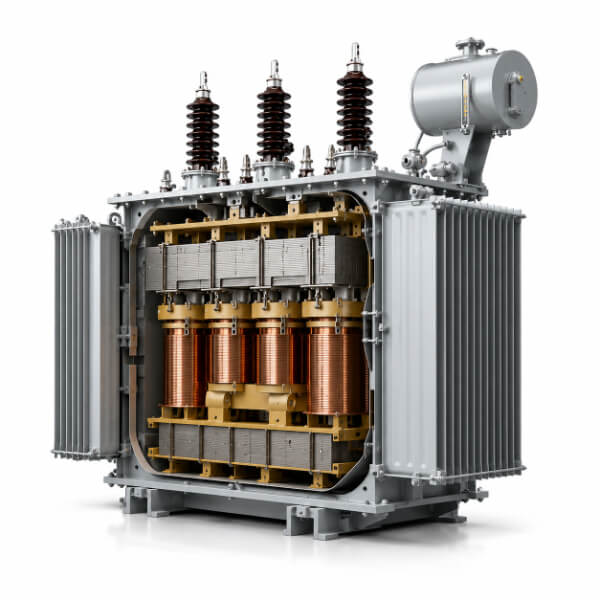
No matter the size, every transformer starts with the same two things: a core and windings. The core is built from thin sheets of silicon steel stacked together. Its only job is to carry magnetic flux. Think of it as the skeleton that makes energy transfer possible.
Around that core, you’ll find the windings – usually copper or aluminum coils. One set is for high voltage, another for low voltage. These are the actual “wires” where current flows. Between the core and the windings, and also between different winding layers, there are insulation pieces (pressboard, paper, or synthetic materials). Without them, electricity would jump where it shouldn’t.
Finally, internal leads connect different sections of the windings and bring the electrical path up to the bushings (which we’ll get to later). Those leads are carefully routed and insulated, because inside the tank everything is packed tight.
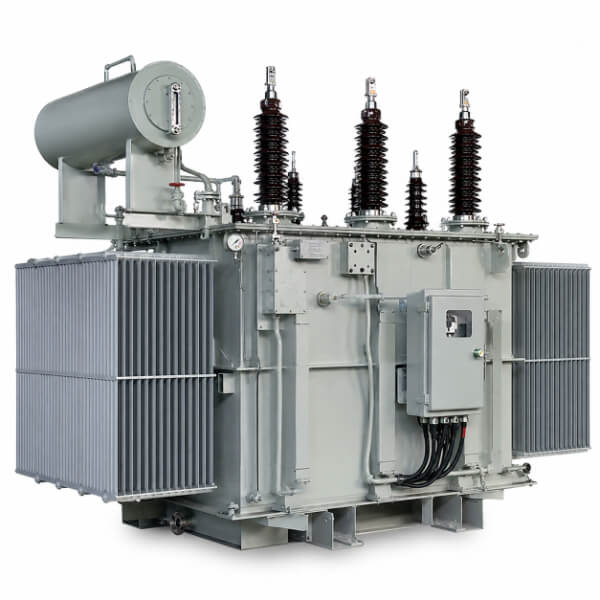
In an oil‑filled transformer, the entire core‑and‑coil assembly is submerged in transformer oil. This oil is not fuel; it’s a highly refined mineral oil that does three things: insulates, cools, and helps extinguish any internal arcing. You can call it the lifeblood of the unit.
The tank itself holds everything together – oil, core, windings, and leads. But a plain steel tank doesn’t shed heat fast enough. That’s why you see those ribbed panels or bolt‑on radiators on the outside. Some larger units use forced‑air or forced‑oil coolers, but the idea is the same: get rid of the heat generated by the windings and core.
As the oil heats up, it expands. To handle that expansion without bursting the tank, there is a conservator (many people call it an oil preservation tank or simply “oil pillow”) mounted above the main tank. It breathes in and out as oil volume changes, keeping the main tank full at all times.
Transformers can live for decades, but they need watchdogs. The most famous one is the Buchholz relay (gas relay). It sits in the pipe between the main tank and the conservator. If a minor fault produces gas bubbles, the relay traps them and sends an alarm. If a major fault creates a sudden oil surge, the relay trips the breaker instantly.
Outside air that enters the conservator carries moisture and dust. That’s where the silica gel breather comes in – a transparent canister filled with blue or orange gel that absorbs humidity from incoming air. When the gel turns pink or white, you know it’s saturated.
For overpressure events (say, a short circuit that vaporizes oil), a pressure relief valve pops open for a fraction of a second, then reseals. Without it, the tank could literally split open.
You’ll also find a thermometer (often with a dial and a capillary tube) measuring top oil temperature, and sometimes winding temperature simulators. Operators rely on these readings to decide if the transformer is overloaded or has a cooling problem.
Some larger transformers include an oil purifier – a small tank filled with adsorbent material that continuously filters out water and sludge from the oil. It’s not flashy, but it extends insulation life by years.
The internal leads have to pass through the tank wall to reach the outside world. That’s what porcelain or composite bushings do. They look like big insulator cups or pillars. Inside each bushing, a conductor runs down to the winding, while the porcelain body keeps the high voltage away from the grounded tank.
On top of the tank, the nameplate is your only reliable source of truth – it tells you the MVA rating, voltages, connection group (like Dyn11 or Yyn0), impedance, and serial number. Never trust painted‑on markings from ten years ago.
For maintenance, every oil‑filled tank has at least one oil drain valve at the bottom. And you’ll always see a clearly marked grounding lug welded to the tank – that’s where you connect the station grounding grid to protect people from fault currents.
Most power transformers include a tap changer. It’s a switch mechanism connected to the high‑voltage winding that adds or removes a few turns. This adjusts the output voltage slightly when the incoming grid voltage drifts. De‑energized tap changers (DETC) can only be operated when the transformer is completely disconnected from power. On‑load tap changers (OLTC) work while the transformer is live, but they are much more complex, with a separate oil compartment and a motor drive.
If the transformer is indoors (like inside a building or a wind turbine tower), you often find dry type units. No oil at all. The core and windings are either cast in epoxy resin or wrapped with multiple layers of insulation and then left exposed to air. Cooling happens naturally or with built‑in fans.
Because there is no oil, all the oil‑related parts vanish: no conservator, no Buchholz relay, no silica gel breather, no oil drain valve, and no oil purifier. But the electrical core – the iron core, windings, internal insulation, leads, bushings, nameplate, and grounding lug – remains exactly the same. The tap changer, if present, is a dry‑type design as well.
So when someone asks “what’s inside a power transformer?”, the honest answer is: it depends on whether it’s oil immersed or dry type. But for the oil‑filled workhorses of the grid, the list is long – and every single piece, from the smallest gasket to the main core, serves a purpose. After two decades in the field, I’ve learned that skipping any one of them is asking for trouble.


